The Most Common Reason for Families to Adopt an at-home Father Arrangement Is Because
Learning Objectives
- Describe why many children throughout history have not lived in a nuclear family.
- Sympathise the status of the nuclear family in the United States since the colonial period.
- Describe the major marriage and family arrangements in the United States today.
A family is a group of 2 or more than people who are related by blood, union, adoption, or a mutual commitment and who care for 1 another. Defined in this way, the family unit is universal or nearly universal: Some class of the family has existed in every society, or nearly every society, that nosotros know near (Starbuck, 2010). However it is also true that many types of families have existed, and the cantankerous-cultural and historical record indicates that these unlike forms of the family can all "work": They provide practical and emotional back up for their members and they socialize their children.
It is important to continue this last statement in listen, considering Americans until the concluding few decades thought of only one type of family, and that is the nuclear family: A married heterosexual couple and their immature children living past themselves under i roof. The nuclear family has existed in almost societies with which scholars are familiar. An extended family, which consists of parents, their children, and other relatives, has a nuclear family at its core and was quite common in prehistoric societies. Many one-parent families begin every bit (two-parent) nuclear families that dissolve upon divorce or separation or, more rarely, the death of 1 of the parents. In contempo decades, one-parent families have become more mutual in the United States because of divorce and births out of wedlock, but they were actually very common throughout virtually of man history because many spouses died early in life and because many babies were born out of wedlock.

Although the nuclear family is a mutual family arrangement today, historically many children lived with just ane parent because spouses died early and many babies were built-in out of wedlock.
Although many prehistoric societies featured nuclear families, a few societies studied by anthropologists have not had them. In these societies, a male parent does not live with a woman after she has his child and sees them either irregularly or not at all. Despite the absence of a father and the lack of a nuclear family, this blazon of family system seems to have worked well in these societies. In particular, children are cared for and grow up to be productive members of their societies (Smith, 1996).
These examples do not invalidate the fact that nuclear families are almost universal. But they do indicate that the functions of the nuclear family can exist accomplished through other family unit arrangements. If that is true, possibly the oft-cited business over the "breakdown" of the 1950s-style nuclear family unit in modern America is at to the lowest degree somewhat undeserved. Every bit indicated by the examples but given, children can and do thrive without two parents. To say this is meant neither to extol divorce, births out of wedlock, and fatherless families nor to minimize the issues they may involve. Rather, information technology is meant simply to betoken that the nuclear family is not the simply feasible grade of family arrangement (Seccombe, 2012).
In fact, although nuclear families remain the norm in most societies, in practice they are something of a historical rarity: Until most a century agone, many spouses died by their mid-forties, and many babies were born out of union. In medieval Europe, for example, people died early from affliction, malnutrition, and other problems. One issue of early on bloodshed was that many children could expect to outlive at least i of their parents and thus essentially were raised in one-parent families or in stepfamilies (Gottlieb, 1993).
During the American colonial period, different family unit types abounded, and the nuclear family was by no means the merely blazon (Coontz, 1995). Nomadic Native American groups had relatively small nuclear families, while nonnomadic groups had larger extended families. Because nuclear families among African Americans slaves were difficult to achieve, slaves adapted by developing extended families, adopting orphans, and taking in other people not related by claret or marriage. Many European parents of colonial children died considering average life expectancy was simply 45 years. The one-tertiary to half of children who outlived at least one of their parents lived in stepfamilies or with just their surviving parent. Mothers were and so busy working the country and doing other tasks that they devoted relatively trivial time to child care, which instead was entrusted to older children or servants.
Moving much frontward in U.s. history, an important modify in American families occurred during the 1940s afterwards World War Ii ended. Equally men came home after serving in the armed forces in Europe and Japan, books, magazines, and newspapers exhorted women to have babies, and babies they did have: People got married at younger ages and the birth rate soared, resulting in the at present famous baby nail generation. Meanwhile, divorce rates dropped. The national economic system thrived every bit car and other factory jobs multiplied, and many families for the commencement time could dream of owning their own homes. Suburbs sprang up, and many families moved to them. Many families during the 1950s did indeed fit the Exit Information technology to Beaver model of the breadwinner-homemaker suburban nuclear family. Following the Depression of the 1930s and the war of the 1940s, the 1950s seemed an almost idyllic decade.
Fifty-fifty so, less than 60 pct of American children during the 1950s lived in breadwinner-homemaker nuclear families. Moreover, many lived in poverty, as the poverty rate and so was almost twice every bit loftier every bit it is today. Teenage pregnancy rates were almost twice as high as today. Although not publicized back then, alcoholism and violence in families were common. Historians have found that many women in this era were unhappy with their homemaker roles, Mrs. Cleaver (Beaver'south female parent) to the contrary, suffering from what Betty Friedan (1963) famously called the "feminine mystique."
During the 1960s and 1970s, women began to enter the labor force. They did so to increase their families' incomes and to reach greater self-fulfillment. More than 60 per centum of married women with children under 6 years of age are at present in the labor force, compared to less than 19 percent in 1960. At near the same time, divorce rates increased for several reasons that we examine later in this chapter. Changes in the American family had begun, and forth with them various controversies and bug.
Marriage and the Family in the United states Today
In the U.s.a. today, marriage remains an important establishment. Only about 27 percent of all adults (18 or older) have never been married, 56 percentage are currently married, 10 per centum are divorced, and 6 per centum are widowed (see Figure 10.one "Marital Status of the US Population xviii Years of Historic period or Older, 2010"). Thus 72 percent of American adults have been married, whether or not they are currently married. Considering more than half of the never-married people are under 30, it is off-white to say that many of them will be getting married former in the future. When we expect just at people aged 45–54, about 87 percent are currently married or had been married at some point in their lives. In a 2010 poll, simply 5 percentage of Americans under age 30 said they did non desire to get married (Luscombe, 2010). These figures all indicate that wedlock continues to exist an of import platonic in American life, even if not all marriages succeed. Every bit one sociologist has said, "Getting married is a way to show family and friends that y'all have a successful personal life. Information technology's like the ultimate merit bluecoat" (Luscombe, 2010).
Although marriage remains an of import institution, ii recent trends practice advise that its importance is failing for some segments of the population (Cohn, Passel, Wang, & Livingston, 2011). Starting time, although 71 percent of adults take been married, this figure represents a drop from 85 per centum in 1960. 2d, instruction profoundly affects whether we marry and stay married, and marriage is less common among people without a college caste.
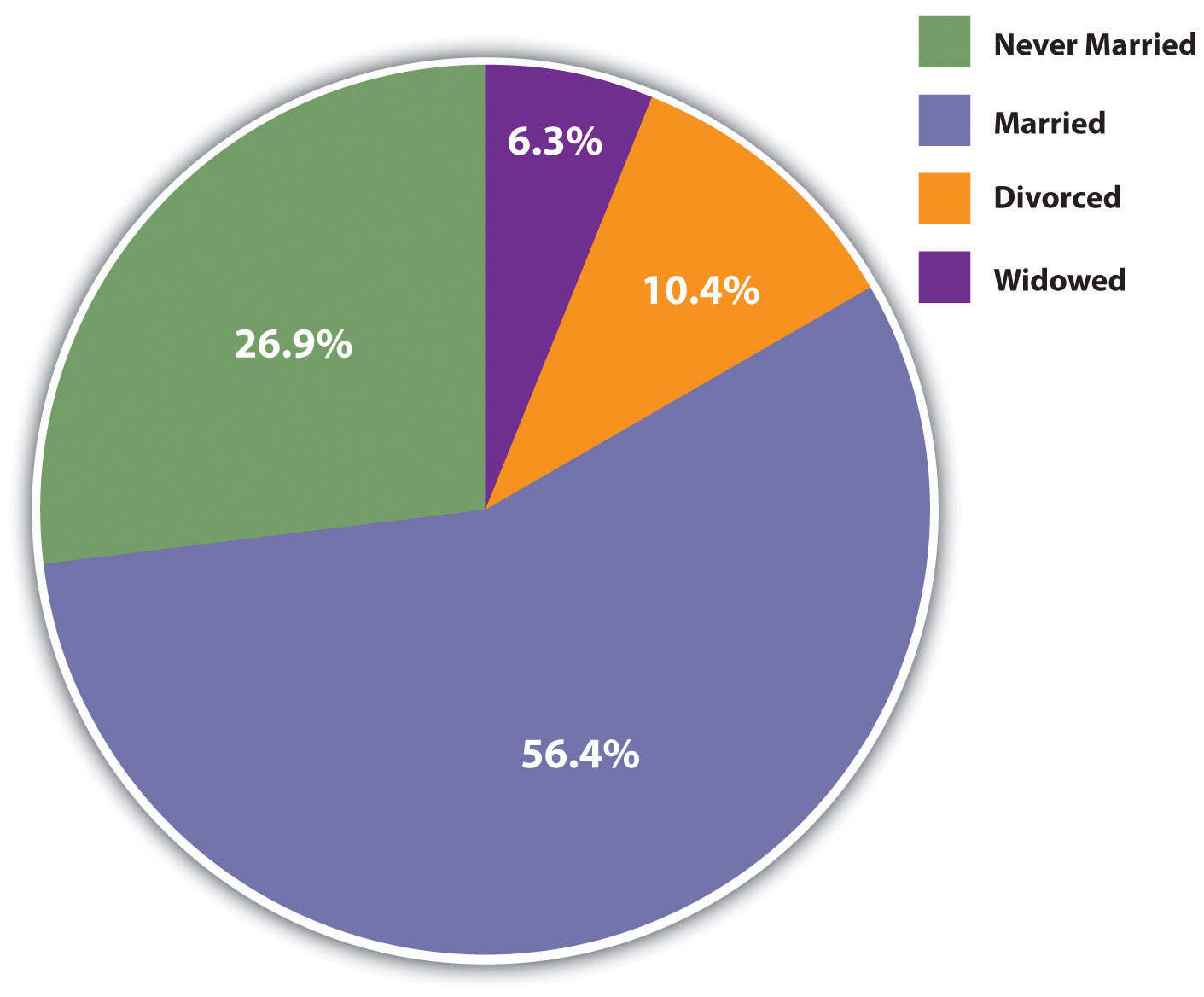
Figure 10.1 Marital Status of the Usa Population 18 Years of Age or Older, 2010. Source: Data from U.s.a. Census Bureau. (2012). Statistical abstruse of the United States: 2012. Washington, DC: United states of america Government Press Office. Retrieved from http://world wide web.census.gov/compendia/statab.
Recent figures provide striking prove of this relationship. Almost ii-thirds (64 pct) of college graduates are currently married, compared to less than half (47 percent) of high schoolhouse graduates and high schoolhouse dropouts combined. People with no more than a loftier schoolhouse degree are less likely than college graduates to ally at all, and they are more likely to get divorced, every bit we shall discuss over again later, if they exercise marry.
This divergence in marriage rates worsens the financial situation that people with lower education already confront. As one observer noted, "As wedlock increasingly becomes a phenomenon of the better-off and ameliorate-educated, the incomes of two-earner married couples diverge more from those of struggling single adults" (Marcus, 2011). One of the many consequences of this educational activity gap in marriage is that the children of one-parent households are less likely than those of two-parent households to graduate high schoolhouse and to nourish college. In this mode, a parent'south low education helps to perpetuate low education among the parent'southward children.
The United States Compared to Other Democracies
In several ways, the United states of america differs from other Western democracies in its view of marriage and in its beliefs involving marriage and other intimate relationships (Cherlin, 2010; Hull, Meier, & Ortyl, 2012). First, Americans place more than accent than their Western counterparts on the ideal of romantic love as a basis for marriage and other intimate relationships and on the cultural importance of marriage. Second, the United States has higher rates of union than other Western nations. Third, the United states too has higher rates of divorce than other Western nations; for case, 42 percent of American marriages end in divorce after xv years, compared to only 8 pct in Italian republic and Espana. Fourth, Americans are much more than likely than other Western citizens to remarry once they are divorced, to cohabit in short-term relationships, and, in general, to movement from one intimate human relationship to another, a practise chosen serial monogamy. This practice leads to instability that can have negative impacts on whatever children that may be involved and besides on the adults involved.

Americans identify more accent than Europeans on the ideal of romantic love equally the basis for wedlock. This accent helps account for why the The states has a higher divorce rate than many European nations.
The US emphasis on romantic love helps account for its high rates of union, divorce, and series monogamy. It leads people to want to be in an intimate human relationship, marital or cohabiting. Then when couples get married because they are in love, many chop-chop notice that passionate romantic beloved can speedily fade; considering their expectations of romantic beloved were then loftier, they become more disenchanted once this happens and unhappy in their wedlock. As sociologist Andrew J. Cherlin (2010, p. iv) observes, "Americans are conflicted near lifelong marriage: they value the stability and security of marriage, merely they tend to believe that individuals who are unhappy with their marriages should be allowed to end them." Still, the ideal of romantic love persists even later on divorce, leading to remarriage and/or other intimate relationships.
Children and Families
The United States has about 36 million families with children under eighteen. Most lxx percent of these are married-couple families, while 30 pct (upwardly from about 14 per centum in the 1950s) are one-parent families. Well-nigh of these latter families are headed past the female parent (see Figure 10.2 "Family unit Households with Children under 18 Years of Historic period, 2010").

Figure 10.2 Family Households with Children under 18 Years of Historic period, 2010. Source: Information from United states of america Census Bureau. (2012). Statistical abstract of the United States: 2012. Washington, DC: United states of america Regime Printing Office. Retrieved from http://www.demography.gov/compendia/statab.
The proportion of families with children under 18 that have only 1 parent varies significantly by race and ethnicity: Latino and African American families are more likely than white and Asian American households to have simply ane parent (encounter Figure x.3 "Race, Ethnicity, and Pct of Family Groups with Only 1 Parent, 2010"). Similarly, whereas 30 pct of all children do not live with both their biological parents, this figure, as well, varies past race and ethnicity: virtually 61 percent of African American children, 15 percent of Asian children, 33 percentage of Latino children, and 23 percent of non-Latino white children.

Figure 10.3 Race, Ethnicity, and Percentage of Family unit Groups with Only One Parent, 2010. Source: Information from US Census Bureau. (2012). Statistical abstract of the United States: 2012. Washington, DC: US Government Press Office. Retrieved from http://world wide web.census.gov/compendia/statab.
We will hash out several other issues affecting children later in this chapter. But before we move on, it is worth noting that children, despite all the joy and fulfillment they and so frequently bring to parents, also tend to reduce parents' emotional well-being. As a recent review summarized the evidence, "Parents in the U.s.a. experience low and emotional distress more oftentimes than their childless adult counterparts. Parents of immature children study far more depression, emotional distress and other negative emotions than non-parents, and parents of grown children have no better well-being than adults who never had children" (Simon, 2008, p. 41).
Children have these effects considering raising them can exist both stressful and expensive. Depending on household income, the boilerplate child costs parents between $134,000 and $270,000 from nascency until historic period eighteen. Higher educational activity plainly tin can cost tens of thousands of dollars beyond that. Robin W. Simon (2008) argues that American parents' stress would exist reduced if the regime provided better and more than affordable twenty-four hour period intendance and afterwards-schoolhouse options, flexible work schedules, and tax credits for various parenting costs. She as well thinks that the expectations Americans take of the joy of parenthood are unrealistically positive and that parental stress would be reduced if expectations became more realistic.
Cardinal Takeaways
- Although the nuclear family has been very common, many children throughout history take not lived in a nuclear family unit, in office because a parent would die at an early historic period.
- Most Americans eventually marry. This fact means that marriage remains an important ideal in American life, even if non all marriages succeed.
- Near 30 percent of children live with only one parent, nearly always their female parent.
For Your Review
- Write a brief essay in which you lot describe the advantages and disadvantages of the 1950s-blazon nuclear family in which the father works outside the dwelling house and the mother stays at home.
- The text notes that most people eventually marry. In view of the fact that and then many marriages end in divorce, why practise you think that so many people continue to ally?
- Some of the children who live but with their mothers were born out of wedlock. Do you retrieve the parents should have married for the sake of their child? Why or why not?
References
Cherlin, A. J. (2010). The marriage-go-round: The state of marriage and the family in America today. New York, NY: Vintage.
Cohn, D., Passel J., Wang, Westward., & Livingston, G. (2011). Barely one-half of U.s.a. adults are married—a record low. Washington, DC: Pew Research Centre.
Coontz, S. (1995, summer). The way we weren't: The myth and reality of the "traditional" family unit. National Forum: The Phi Kappa Phi Journal, 11–fourteen.
Friedan, B. (1963). The feminine mystique. New York, NY: W. W. Norton.
Gottlieb, B. (1993). The family in the Western world from the black death to the industrial age. New York, NY: Oxford University Press.
Hull, K. E., Meier, A., & Ortyl, T. (2012). The irresolute landscape of love and matrimony. In D. Hartmann & C. Uggen (Eds.), The contexts reader (second ed., pp. 56–63). New York, NY: W. W. Norton.
Luscombe, B. (2010, November eighteen). Who needs marriage? A changing institution. Time. Retrieved from http://www.time.com/time/magazine/article/0,9171,2032116,2032100.html.
Marcus, R. (2011, Dec 18). The union gap presents a real cost. The Washington Post. Retrieved from http://www.washingtonpost.com/opinions/the-wedlock-gap-presents-a-existent-cost/2011/12/16/gIQAz24DzO_story.html?hpid=z3.
Seccombe, Chiliad. (2012). Families and their social worlds (2nd ed.). Upper Saddle River, NJ: Pearson.
Simon, R. W. (2008). The joys of parenthood, reconsidered. Contexts, vii(2), 40–45.
Smith, R. T. (1996). The matrifocal family: Power, pluralism, and politics. New York, NY: Routledge.
Starbuck, G. H. (2010). Families in context (2nd ed.). Boulder, CO: Prototype.
Source: https://courses.lumenlearning.com/suny-socialproblems/chapter/10-1-overview-of-the-family/

Post a Comment for "The Most Common Reason for Families to Adopt an at-home Father Arrangement Is Because"