Ever Tried Everfailedno Matter Try Again Fail Again Fail Better
50 years ago, in the summer of 1966, Samuel Beckett wrote a short story called Ping. It begins:
All known all white bare white trunk fixed one yard legs joined like sewn. Light heat white floor i certain yard never seen. White walls ane yard by two white ceiling one square grand never seen. Bare white body stock-still only the eyes just just. Traces blurs lite gray almost white on white. Hands hanging palms front end white feet heels together right angle. Low-cal heat white planes shining white bare white body fixed ping elsewhere.
The kickoff fourth dimension I read it, it reminded me of the chant-like rhythm of BBC radio'due south aircraft forecast: a hypnotic menstruum of words the meaning of which is initially utterly obscure. But persevere and patterns emerge: "moderate or good, occasionally poor after"/"white walls", "one square g", "white scars". In both cases, we presently realise we are within a organization of words performing very defined tasks, admitting ones only understood past initiates. Only while fathoming the shipping forecast can be accomplished relatively speedily, initiation into the system of words Beckett was working with in the mid-1960s is more complicated, not least because the organisation was corrupted, a failure, every bit were all the systems Beckett devised during his long career.
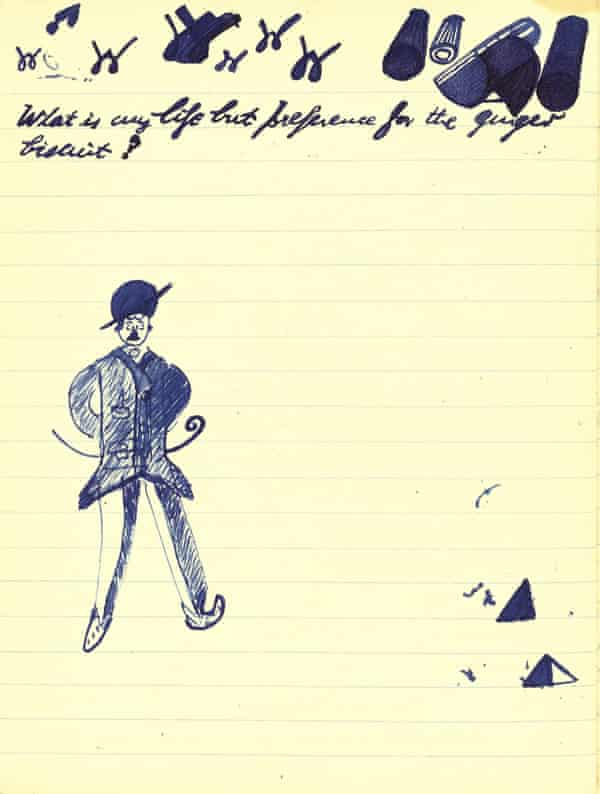
Beckett came to believe failure was an essential role of whatsoever artist's work, even equally it remained their responsibility to try to succeed. His best-known expressions of this philosophy announced at the end of his 1953 novel The Unnamable – " … you must proceed. I tin't become on. I'll keep" – and in the 1983 story Worstward Ho – "Ever tried. Always failed. No matter. Try once more. Neglect again. Fail meliorate."
Beckett had already experienced plenty of creative failure by the fourth dimension he developed it into a poetics. No ane was willing to publish his first novel, Dream of Fair to Middling Women, and the book of short stories he salvaged from it, More Pricks Than Kicks (1934), sold disastrously. The collection, which follows Beckett'south mirror image Belacqua Shuah (SB/BS) around Dublin on a series of sexual misadventures, features moments of brilliance, is a challenging and frustrating read. Jammed with allusion, tricksy syntax and obscure vocabulary, its prose must be hacked through like a thorn bush. As the narrator comments of one character'southward hymeneals spoken language, it is "rather too densely packed to gain the general suffrage".
Throughout this period, Beckett remained very much nether the influence of James Joyce, whose circle he joined in Paris in the belatedly 20s. Submitting a story to his London editor, Beckett blithely noted that it "stinks of Joyce", and he was right. Simply compare his, "and past the holy fly I wouldn't recommend you to enquire me what class of a tree they were under when he put his hand on her and enjoyed that. The thighjoy through the fingers. What does she want for her thighbeauty?" with this, from Ulysses: "She let free sudden in rebound her nipped rubberband garter smackwarm against her smackable woman's warmhosed thigh."
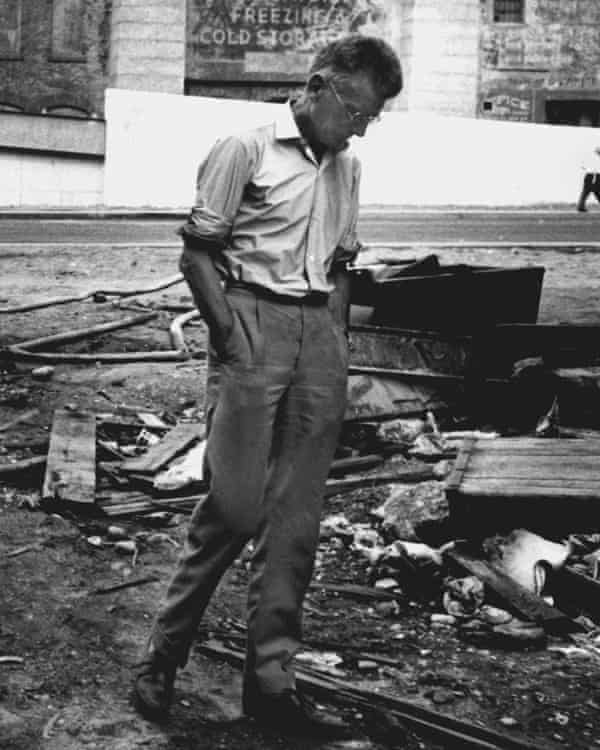
Beckett was rudderless in his belatedly 20s and early 30s (which, thanks to the assart he received following his begetter's death, he could just about afford to be). He wandered for much of the 1930s, having walked out of a lectureship at Trinity College, Dublin. He returned to Paris, then moved to London, where he wrote the novel Irish potato and underwent Kleinian psychoanalysis. He toured Germany, and in 1937 settled in Paris, where he lived until his expiry in 1989. During the 2nd world war, he joined the resistance, fled Paris to escape abort, and lived penuriously in Roussillon. These years of wandering and war and desire influenced the character of his later on piece of work. In 1945, working at a Red Cross infirmary in Saint-Lô, he wrote an essay about the ruins of the town, "bombed out of being in ane dark", and described "this universe become conditional". Versions of this ruin strewn mural and postal service-disaster environment would characterise the settings and atmosphere of much of his afterwards work.
Although Beckett had written some poetry in French before the war, it was in its aftermath he resolved to commit fully to the language, "because in French information technology is easier to write without manner". This decision, and his switch to the first-person vocalization, resulted in one of the more amazing artistic transformations in 20th-century literature, equally his clotted, exhaustingly cocky-conscious early on manner gave way to the strange journeys described, and tortured psyches inhabited, in the four long stories he wrote in the course of a few months during 1946. The Expelled, The Calmative and The Stop, and to a lesser extent Outset Love (which Beckett, always his own harshest judge, considered junior and suppressed for many years), describe the descent of their unnamed narrators (possibly the same human) from bourgeois respectability into homelessness and death.
Nosotros witness a succession of evictions: from the family domicile, some kind of institution, hovels and stables, basements and benches. There is a nagging suspicion that the initial expulsion in each story is a form of nascence, ofttimes characterised in fierce terms. (In the novel Watt, a character's birth is described as his "ejection"; in Waiting for Godot, Pozzo says nativity takes place "astride of a grave".) These journeys get surrogates for the journey we accept through life, as Beckett perceives it: bewildered, disordered and provisional, with simply brief respites from a general strife. In the final scene of The Terminate, the narrator is chained to a leaking gunkhole, his life seemingly draining away. It is the monumental bleakness of works such every bit these (frequently shot through with splinters of sharp humour), that Harold Pinter was writing of in a letter of 1954 when he chosen Beckett "the most courageous, remorseless writer going, and the more than he grinds my nose in the shit the more I am grateful to him".
Following the iv stories, Beckett reached an impasse in his writing with the Texts for Goose egg (1955). Linguistic communication is on the verge of breakup in these brief, numbered pieces. The disdain in which words are held tin be summed up with the phrase "the head and its anus the mouth", from #10. In #11 a crunch point is reached: "No, nothing is nameable, tell, no, nil tin can be told, what then, I don't know, I shouldn't accept begun." Hither the playfulness of the Three Dialogues, and the tortured courage of The Unnamable's "I'll continue", has soured into hopelessness.
Discussing his writing in the early 60s, Beckett described a process of "getting down below the surface" towards "the authentic weakness of being". Failure remained unavoidable because "[west]hatever is said is then far from the experience" that "if you really go down to the disaster, the slightest eloquence becomes unbearable". Thus, the narrowing of possibilities that the Texts for Nothing depict leads into the claustrophobia of the "closed space" works of the 1960s. Beginning with the novel How Information technology Is (1961), told past a nameless man lying in darkness and mud, and continuing with All Strange Away (1964), Imagination Dead Imagine (1965) and the aforementioned Ping, Beckett describes a serial of geometrically distinct spaces (cubes, rotundas, cylinders) where white bodies prevarication, or hang, singly or in pairs. Beckett had reread Dante, and something of his Hell and Purgatory characterises these claustrophobic spaces. The language with which they are described is so fragmented that it is hard to orient ourselves: nosotros are in a system of words where multiple paths of meaning co-operative from every judgement, not on the level of interpretation but of basic comprehension. Take for example the opening line of Imagination Dead Imagine:
No trace anywhere of life, you lot say, pah, no difficulty there, imagination non dead yet, yes, dead good, imagination dead imagine.
Does the "you say" expect back to "No trace anywhere ", or does information technology conceptualize "pah, no difficulty in that location"? As Adrian Hunter writes:
What punctuation there is has the event not of profitable interpretation but of further breaking down any concatenation of pregnant in the linguistic communication. A simple orientational phrase similar "you lot say" hovers uncertainly between its commas; instead of securing the speech acts that surround information technology, it operates as a kind of revolving door by which one both exits and enters the various semantic fields in the passage.
In Beckett's next piece of work, Enough (1965), he abandoned both the commencement person and the comma (only a handful are plant in all of his after prose), his sentences becoming terse every bit bulletins, curt afterthoughts ("modifier after modifier", in one description) typically consisting of mono- or disyllabic words, that try – and fail – to clarify whatsoever image or awareness he is attempting to express. Hugh Kenner has written memorably of this phase that Beckett:
Seems unable to punctuate a judgement, let alone construct one. More than and more deeply he penetrates the heart of utter incompetence, where the simplest pieces, the merest three-give-and-take sentences, fly apart in his hands. He is the non-maestro, the anti-virtuoso, habitué of not-form and anti-matter, Euclid of the dark zone where all signs are negative, the comedian of utter disaster.
Kenner's evaluation echoes Beckett's own words from a 1956 New York Times interview, when he assorted his approach with that of Joyce: "He's tending towards omniscience and omnipotence as an creative person. I'm working with impotence, ignorance". The impasse reached in the Texts for Nothing continues in a story like Lessness (1969), which really runs out of words: the 2d half of the text just duplicates the first half with the words reordered, leaving usa, in JM Coetzee's clarification, with "a fiction of net aught on our hands, or rather with the obliterated traces of a consciousness elaborating and dismissing its ain inventions".
Strategies like these brand navigating Beckett'south piece of work even more challenging for the reader, to the caste that some critics decided pointlessness was its very point. In the case of Ping, this position is strongly rebutted in a 1968 essay by David Lodge. While acknowledging that it is "extraordinarily hard to read through the unabridged piece, short as it is, with sustained concentration", the words soon offset to "slide and mistiness earlier the eyes, and to echo bewilderingly in the ear", he concludes that "the more than closely acquainted we become with Ping, the more than certain nosotros go that it does matter what words are used, and that they refer to something more than specific than the futility of life or the futility of art."
Beckett's closed-infinite phase culminates in The Lost Ones (1970), a nightmarish vision of a sealed cylinder within which "fugitives" circulate until futility or death overcomes them. The Lost Ones updates Dante into what one reviewer called "the fine art of a gas-bedroom earth". Information technology is written at an anthropological remove, the cylinder described in punishing item, and at punishing length. For all the clarity of its language compared with Ping or Lessness, it is the most forbidding of his shorter prose works.
It was nearly a decade before any more pregnant short prose emerged, simply when it did another shift had taken place. The terrifying closed spaces were collapsed and gone, replaced by the twilit grasslands of Stirrings Yet (1988), or the isolated cabin, "zone of stones" and ring of mysterious sentinels in Ill Seen Ill Said (1981). Linguistic communication remains problematic, but a level of acceptance has been reached. The phrase "what is the incorrect word?" recurs in Ill Seen Ill Said, every bit if to say: "Of form linguistic communication is bereft, merely approximation is better than nil":
Granite of no mutual variety assuredly. Black as jade the jasper that flecks its whiteness. On its what is the wrong word its uptilted face obscure graffiti.
In these stories, written in the final decade of Beckett'southward life and in which stylised settings blend with autobiographical material, often from his childhood, he seems to evangelize us to the source of his creativity, to the moment where an idea sparks in the conscious listen. The terrain and structures of Ill Seen Ill Said seem to come up into existence at the very moment we read them. "Careful," he writes, tentatively bringing his creation into the world equally if guarding a friction match flame:
The two zones form a roughly circular whole. Every bit though outlined past a trembling hand. Diameter. Careful. Say one furlong.
It is an irony of Beckett's posthumous reputation that his plays are now far improve known than his prose, although he considered the latter his primary focus. That he wrote some of the greatest short stories of the 20th century seems to me an uncontroversial claim, yet his work in this genre is comparatively obscure. Partly this is a problem of classification. As ane bibliographical note puts information technology: "The stardom between a discrete short story and a fragment of a novel is not always articulate in Beckett's work." Publishers take colluded in this confusion: as show of the British phobia of brusque stories goes, it's hard to beat John Calder's blurbing of the 1,500-discussion story Imagination Expressionless Imagine as "perhaps the shortest novel always published". Then too there are examples such as William Trevor'due south exclusion of Beckett from the 1989 Oxford Book of Irish Short Stories for the nonsense reason that he expressed his ideas "more skilfully in another medium", or Anne Enright excluding him from her ain choice for Granta.
I suspect the real trouble with Beckett'south short fiction is its difficulty, and that his greatest achievements in the course practice not comply with what some gatekeepers suppose to be the genre's defining traits. Unfortunate as the resulting neglect might be, this is a fitting position to exist occupied by a writer who consistently struggled to develop new forms. If the history of the short story were mapped, he would belong in a distant region. The isolation would not affair. "I don't find solitude agonising, on the contrary", he wrote in a letter of the alphabet of 1959. "Holes in paper open and take me fathoms from anywhere."
Source: https://www.theguardian.com/books/booksblog/2016/jul/07/samuel-beckett-the-maestro-of-failure

Post a Comment for "Ever Tried Everfailedno Matter Try Again Fail Again Fail Better"