Performance Art Activities to Do With the Audience During a Studio Talk

Dance is a blazon of performing art practiced all over the world.
The performing arts are arts such as music, dance, and drama which are performed for an audition.[one] It is dissimilar from visual arts, which is the use of paint, canvas or various materials to create physical or static art objects. Performing arts include a range of disciplines which are performed in front of a live audience, including theatre, music, and dance.
Theatre, music, trip the light fantastic and object manipulation, and other kinds of performances are nowadays in all human being cultures. The history of music and dance engagement to pre-historic times whereas circus skills date to at least Ancient Egypt. Many performing arts are performed professionally. Operation can be in purpose built buildings, such as theatres and opera houses, on open air stages at festivals, on stages in tents such as circuses and on the street.
Live performances earlier an audience are a form of entertainment. The development of audio and video recording has allowed for private consumption of the performing arts. The performing arts often aims to express one's emotions and feelings.[2]
Performers [edit]

Performing artists in Kyoto, Japan
Artists who participate in performing arts in front of an audience are called performers. Examples of these include actors, comedians, dancers, magicians, circus artists, musicians, and singers. Performing arts are too supported by workers in related fields, such as songwriting, choreography and stagecraft. Performers often accommodate their advent, such as with costumes and stage makeup, stage lighting, and sound.
Types [edit]
Performing arts may include dance, music, opera, theatre and musical theatre, magic, illusion, mime, spoken word, puppetry, circus arts, professional person wrestling and operation fine art.
There is besides a specialized form of art, in which the artists perform their work live to an audience. This is chosen operation fine art. Most functioning fine art as well involves some form of plastic art, possibly in the creation of props. Dance was often referred to as a plastic art during the Modern trip the light fantastic era.[3]
Theatre [edit]
Theatre is the branch of performing arts concerned with acting out stories in front of an audition, using a combination of speech, gesture, music, dance, sound, and spectacle. Whatsoever one or more of these elements is considered performing arts. In addition to the standard narrative dialogue fashion of plays, theater takes such forms every bit plays, musicals, opera, ballet, illusion, mime, classical Indian dance, kabuki, mummers' plays, improvisational theatre, comedy, pantomime, and non-conventional or gimmicky forms like postmodern theatre, postdramatic theatre, or performance art.
Trip the light fantastic [edit]

In the context of performing arts, dance more often than not refers to human movement, typically rhythmic and to music, used as a course of audience amusement in a functioning setting. Definitions of what constitutes trip the light fantastic are dependent on social, cultural, aesthetic, creative, and moral constraints and range from functional movement (such equally folk trip the light fantastic) to codified, virtuoso techniques such every bit ballet.[4]
In that location is one another modern form of trip the light fantastic toe that emerged in 19th- 20th century with the name of Complimentary trip the light fantastic toe style. This form of dance was structured to create a harmonious personality which included features such as concrete and spiritual freedom. Isadora Duncan was the first female dancer who argued almost "woman of hereafter" and developed novel vector of choreography using Nietzsche's idea of "supreme mind in costless mind".[5]
Dance is a powerful impulse, only the art of trip the light fantastic toe is that impulse channeled by adept performers into something that becomes intensely expressive and that may delight spectators who feel no wish to trip the light fantastic themselves. These 2 concepts of the art of dance—trip the light fantastic as a powerful impulse and dance as a skillfully choreographed fine art practiced largely by a professional person few—are the two nearly of import connecting ideas running through any consideration of the subject. In trip the light fantastic, the connexion between the 2 concepts is stronger than in some other arts, and neither can exist without the other.[4]
Choreography is the art of making dances, and the person who practices this art is called a choreographer.
Music [edit]
Music is an art form which combines pitch, rhythm, and dynamic to create sound. It tin exist performed using a diverseness of instruments and styles and is divided into genres such as folk, jazz, hip hop, pop, and rock, etc. Equally an art form, music can occur in live or recorded formats, and can be planned or improvised.
As music is a protean art, it easily coordinates with words for songs as physical movements exercise in dance. Moreover, it has a adequacy of shaping human behaviors as it impacts our emotions.[six]
History [edit]
Western performing arts [edit]
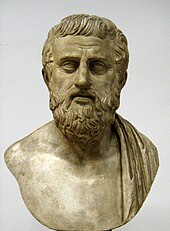
Starting in the 6th century BC, the Classical period of performing art began in Greece, ushered in past the tragic poets such as Sophocles. These poets wrote plays which, in some cases, incorporated dance (encounter Euripides). The Hellenistic period began the widespread use of one-act.
However, by the sixth century AD, Western performing arts had been largely ended, as the Dark Ages began. Between the 9th century and 14th century, performing fine art in the W was express to religious historical enactments and morality plays, organized by the Church in celebration of holy days and other important events.
Renaissance [edit]
In the 15th century performing arts, forth with the arts in full general, saw a revival as the Renaissance began in Italy and spread throughout Europe plays, some of which incorporated dance, which were performed and Domenico da Piacenza credited with the offset use of the term ballo (in De Arte Saltandi et Choreas Ducendi) instead of danza (dance) for his baletti or balli. The term eventually became Ballet. The first Ballet per se is thought to be Balthasar de Beaujoyeulx's Ballet Comique de la Reine (1581).

By the mid-16th century Commedia Dell'arte became popular in Europe, introducing the use of improvisation. This menstruum also introduced the Elizabethan masque, featuring music, trip the light fantastic toe and elaborate costumes as well as professional theatrical companies in England. William Shakespeare'southward plays in the late 16th century developed from this new course of professional operation.
In 1597, the first opera, Dafne was performed and throughout the 17th century, opera would rapidly become the entertainment of choice for the aristocracy in most of Europe, and eventually for large numbers of people living in cities and towns throughout Europe.
Modern era [edit]
The introduction of the proscenium curvation in Italia during the 17th century established the traditional theatre class that persists to this mean solar day. Meanwhile, in England, the Puritans forbade interim, bringing a halt to performing arts that lasted until 1660. After that, women began to announced in both French and English plays. The French introduced a formal dance instruction in the late 17th century.
It is also during this time that the showtime plays were performed in the American Colonies.
During the 18th century, the introduction of the popular opera buffa brought opera to the masses as an attainable grade of operation. Mozart's The Union of Figaro and Don Giovanni are landmarks of the late 18th century opera.
At the plough of the 19th century, Beethoven and the Romantic movement ushered in a new era that led first to the glasses of grand opera and then to the musical dramas of Giuseppe Verdi and the Gesamtkunstwerk (full piece of work of art) of the operas of Richard Wagner leading directly to the music of the 20th century.

The 19th century was a period of growth for the performing arts for all social classes, technical advances such as the introduction of gaslight to theatres, caricatural, minstrel dancing, and variety theatre. In ballet, women brand great progress in the previously male-dominated art.
Mod dance began in the tardily 19th century and early 20th century in response to the restrictions of traditional ballet. The inflow of Sergei Diaghilev'due south Ballets Russes (1909–1929) revolutionized ballet and the performing arts mostly throughout the Western globe, well-nigh importantly through Diaghilev'due south emphasis on collaboration, which brought choreographers, dancers, set designers/artists, composers and musicians together to revitalize and revolutionize ballet. Information technology is extremely complex.
Konstantin Stanislavski's "System" revolutionized acting in the early 20th century, and continues to accept a major influence on actors of stage and screen to the current day. Both impressionism and modern realism were introduced to the phase during this period.
With the invention of the move picture show in the late 19th century by Thomas Edison and the growth of the move pic manufacture in Hollywood in the early 20th century, motion picture became a dominant performance medium throughout the 20th and 21st centuries.
Rhythm and blues, a cultural phenomenon of black America, rose to prominence in the early 20th century; influencing a range of later pop music styles internationally.
In the 1930s Jean Rosenthal introduced what would go modernistic stage lighting, changing the nature of the phase as the Broadway musical became a miracle in the United States.
Postwar [edit]
Mail service-Globe State of war II performing arts were highlighted past the resurgence of both ballet and opera in the Western earth.
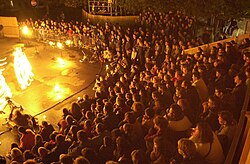
Modern street theatre functioning in La Chaux-de-Fonds
Postmodernism in performing arts dominated the 1960s to big extent.[ citation needed ]
Eastern performing arts [edit]
Middle East [edit]
The primeval recorded theatrical consequence dates dorsum to 2000 BC with the passion plays of Aboriginal Egypt. The story of the god Osiris was performed annually at festivals throughout the culture, mark the known get-go of a long human relationship betwixt theatre and religion.
The most popular forms of theater in the medieval Islamic earth were boob theatre (which included paw puppets, shadow plays and marionette productions) and live passion plays known every bit ta'ziya, where actors re-enact episodes from Muslim history. In item, Shia Islamic plays revolved effectually the shaheed (martyrdom) of Ali's sons Hasan ibn Ali and Husayn ibn Ali. Alive secular plays were known every bit akhraja, recorded in medieval adab literature, though they were less mutual than puppetry and ta'ziya theater.[7]

Valiollah Torabi, Iranian naqqāl (storyteller) of Shahnameh.
Islamic republic of iran [edit]
In Iran there are other forms of theatrical events such every bit Naghali or Naqqāli (story telling), ٰRu-Howzi, Siah-Bazi, Parde-Khani, and Mareke giri. Prior to the twentieth century, storytelling was the most recognized form of entertainment, although today, some forms still remain. One grade, Naghali, was traditionally performed in coffeehouses where the storytellers, or Naghals (Naqqāls), just recited sections of a story at a time, thus retaining regular cliental. These stories were based on events of historical or religious importance and many referenced poetry from the Shahnameh. Oftentimes these stories were altered to bail with the atmosphere or mood of the audience.[eight]
India [edit]

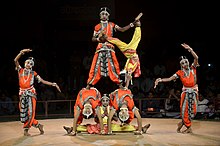
Gotikua folk trip the light fantastic toe is one of the well known performance performed by all boys group dressed in Indian ladies attire Saree
Folk theatre and dramatics can be traced to the religious ritualism of the Vedic peoples in the 2nd millennium BC. This folk theatre of the misty by was mixed with dance, food, ritualism, plus a depiction of events from daily life. The last element made it the origin of the classical theatre of later times. Many historians, notably D. D. Kosambi, Debiprasad Chattopadhyaya, Adya Rangacharaya, etc. accept referred to the prevalence of ritualism amongst Indo-Aryan tribes in which some members of the tribe acted equally if they were wildlife and some others were the hunters. Those who acted every bit mammals similar goats, buffaloes, reindeer, monkeys, etc. were chased by those playing the part of hunters.
Bharata Muni (fl. fifth–second century BC) was an ancient Indian author best known for writing the Natya Shastra of Bharata, a theoretical treatise on Indian performing arts, including theatre, trip the light fantastic, acting, and music, which has been compared to Aristotle's Poetics. Bharata is oft known as the father of Indian theatrical arts. His Natya Shastra seems to be the outset endeavour to develop the technique or rather fine art, of drama in a systematic manner. The Natya Shastra tells us not but what is to be portrayed in a drama, but how the portrayal is to be done. Drama, as Bharata Muni says, is the simulated of men and their doings (loka-vritti). Equally men and their doings take to exist respected on the stage, and then drama in Sanskrit is too known past the term roopaka, which means portrayal.
The Ramayana and Mahabharata can exist considered the starting time recognized plays that originated in Republic of india. These epics provided the inspiration to the earliest Indian dramatists and they do it fifty-fifty today. Indian dramatists such as Bhāsa in the 2nd century BC wrote plays that were heavily inspired by the Ramayana and Mahabharata.
Kālidāsa in the 1st century BC, is arguably considered to be aboriginal India's greatest dramatist. Three famous romantic plays written by Kālidāsa are the Mālavikāgnimitram (Mālavikā and Agnimitra), Vikramōrvaśīyam (Pertaining to Vikrama and Urvashi), and Abhijñānaśākuntala (The Recognition of Shakuntala). The terminal was inspired by a story in the Mahabharata and is the almost famous. It was the starting time to be translated into English and German. In comparison to Bhāsa, who drew heavily from the epics, Kālidāsa can be considered an original playwright.
The side by side bang-up Indian dramatist was Bhavabhuti (c. 7th century). He is said to have written the following three plays: Malati-Madhava, Mahaviracharita and Uttar Ramacharita. Among these three, the concluding two cover between them, the unabridged epic of Ramayana. The powerful Indian emperor Harsha (606–648) is credited with having written three plays: the comedy Ratnavali, Priyadarsika, and the Buddhist drama Nagananda. Many other dramatists followed during the Middle Ages.
There were many performing art forms in the southern part of Bharat, Kerala is such a country with different such art forms like Koodiyattam, Nangyarkoothu, Kathakali, Chakyar koothu, Thirayattam and there were many prominent artists similar Painkulam Raman Chakyar and others.
China [edit]

There are references to theatrical entertainments in China equally early on every bit 1500 BC during the Shang dynasty; they often involved music, clowning and acrobatic displays.
The Tang dynasty is sometimes known equally "The Age of 1000 Entertainments". During this era, Emperor Xuanzong formed an acting schoolhouse known as the Children of the Pear Garden to produce a form of drama that was primarily musical.
During the Han Dynasty, shadow puppetry first emerged equally a recognized form of theatre in China. There were two distinct forms of shadow puppetry, Cantonese southern and Pekingese northern. The two styles were differentiated by the method of making the puppets and the positioning of the rods on the puppets, as opposed to the blazon of play performed past the puppets. Both styles generally performed plays depicting keen adventure and fantasy, rarely was this very stylized form of theatre used for political propaganda. Cantonese shadow puppets were the larger of the two. They were built using thick leather that created more substantial shadows. Symbolic color was also very prevalent; a black face represented honesty, a red one bravery. The rods used to command Cantonese puppets were attached perpendicular to the puppets' heads. Thus, they were non seen by the audition when the shadow was created. Pekingese puppets were more than delicate and smaller. They were created out of thin, translucent leather ordinarily taken from the belly of a donkey. They were painted with vibrant paints, thus they cast a very colorful shadow. The thin rods that controlled their movements were attached to a leather collar at the neck of the boob. The rods ran parallel to the bodies of the puppet then turned at a ninety degree angle to connect to the cervix. While these rods were visible when the shadow was bandage, they laid exterior the shadow of the puppet; thus they did not interfere with the appearance of the effigy. The rods attached at the necks to facilitate the use of multiple heads with one body. When the heads were not being used, they were stored in a muslin book or fabric lined box. The heads were e'er removed at night. This was in keeping with the old superstition that if left intact, the puppets would come to life at night. Some puppeteers went so far as to store the heads in one book and the bodies in another, to further reduce the possibility of reanimating puppets. Shadow puppetry is said to have reached its highest bespeak of artistic evolution in the 11th century earlier becoming a tool of the government.
In the Song dynasty, at that place were many popular plays involving acrobatics and music. These developed in the Yuan dynasty into a more sophisticated class with a four- or five-act structure. Yuan drama spread across China and diversified into numerous regional forms, the best known of which is Beijing Opera, which is still popular today.
Thailand [edit]
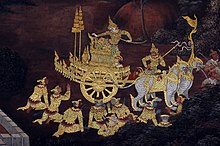
In Thailand, information technology has been a tradition from the Center Ages to phase plays based on plots drawn from Indian epics. In particular, the theatrical version of Thailand'south national epic Ramakien, a version of the Indian Ramayana, remains popular in Thailand fifty-fifty today.
Cambodia [edit]
In Cambodia, inscriptions dating back to the 6th century Advertisement indicates evidences of dancers at a local temple and using puppetry for religious plays. At the ancient capital Angkor Wat, stories from the Indian epics Ramayana and Mahabharata have been carved on the walls of temples and palaces. Like reliefs are found at Borobudur in Republic of indonesia.
Philippines [edit]
In the Philippines, the famous epic poem Ibong Adarna, originally titled "Korido at Buhay na Pinagdaanan ng Tatlong Prinsipeng Magkakapatid na anak nina Haring Fernando at Reyna Valeriana sa Kahariang Berbania" (English: "Corrido and Life Lived past the Iii Princes, children of King Fernando and Queen Valeriana in the Kingdom of Berbania") from the 16th century was written by José de la Cruz during the Spanish era. Aside from theatrical performances, unlike films were produced by different motion-picture show studios/ television productions. The showtime produced "Ang Ibong Adarna" film was produced past LVN Pictures, the biggest film studio in the history of the Philippines.
Florante at Laura is an "awit" or a poem consisting of 12-syllable quatrains with the total championship "Pinagdaanang Buhay ni Florante at ni Laura sa Kahariang Albanya" (English: "The History of Florante and Laura in the Kingdom of Albania") was written by Francisco Balagtas in 1838 during his imprisonment defended to his sweetheart Maria Asuncuion Rivera (nicknamed "M.A.R.", referenced to as "Selya"). The poem has a special part entitled "Kay Selya" (English language: "For Celia") specially defended for Rivera.
The Philippine'southward national hero, José Rizal who is also a novelist, created the two famous poems in the Philippines, Noli Me Tángere (Latin for "Touch me not", with an astute accent added on the final word in accordance with Spanish orthography) (1887) that describes perceived inequities of the Spanish Catholic friars and the ruling regime and El Filibusterismo (translations: The filibusterism; The Destructive or The Subversion, as in the Locsín English translation, are also possible translations, as well known by its alternative English title The Reign of Greed) (1891). The novel's dark theme departs dramatically from the previous novel's hopeful and romantic atmosphere, signifying Ibarra's resort to solving his land'south issues through violent means, after his previous attempt in reforming the state's organisation made no result and seemed impossible with the corrupt mental attitude of the Spaniards toward the Filipinos. These novels were written during the colonization of the Philippines by the Castilian Empire.
All of these literary pieces were under the curriculum of the K-12 Plan for Junior High Schools, Ibong Adarna is under the Grade 7 Curriculum; Florante at Laura (Grade viii); Noli Me Tángere (Form 9); and El Filibusterismo (Grade 10).
Japan [edit]


During the 14th century, there were pocket-size companies of actors in Japan who performed short, sometimes vulgar comedies. A director of one of these companies, Kan'ami (1333–1384), had a son, Zeami Motokiyo (1363–1443), who was considered one of the finest child actors in Japan. When Kan'ami's company performed for Ashikaga Yoshimitsu (1358–1408), the shōgun of Nippon, he implored Zeami to have a court pedagogy for his arts.[9] Afterwards Zeami succeeded his father, he continued to perform and accommodate his fashion into what is today Noh. A mixture of pantomime and vocal acrobatics, the Noh style of theatre has become one of Nippon's most refined forms of theatrical performance.[10]
Japan, later a long period of civil wars and political disarray, was unified and at peace primarily due to shōgun Tokugawa Ieyasu (1600–1668). However, alarmed at the increasing numbers of Christians within the land due to the proselytizing efforts of Christian missionaries, he cut off contact from Nippon to Europe and China and outlawed Christianity. When peace did come up, a flourish of cultural influence and growing merchant class demanded its own entertainment. The first form of theatre to flourish was Ningyō jōruri (commonly referred to as Bunraku). The founder of and main contributor to Ningyō jōruri, Chikamatsu Monzaemon (1653–1725), turned his form of theatre into a truthful fine art form. Ningyō jōruri is a highly stylized class of theatre using puppets, today almost 1⁄3rd the size of a human. The men who command the puppets train their entire lives to become master puppeteers, when they tin can then operate the puppet's caput and right arm and choose to bear witness their faces during the performance. The other puppeteers, decision-making the less important limbs of the puppet, cover themselves and their faces in a black suit, to imply their invisibility. The dialogue is handled by a single person, who uses varied tones of vocalisation and speaking manners to simulate different characters. Chikamatsu wrote thousands of plays during his lifetime, near of which are still used today.
Kabuki began shortly after Bunraku, legend has it by an actress named Okuni, who lived effectually the end of the 16th century. Most of kabuki's fabric came from Noh and Bunraku, and its erratic dance-type movements are as well an effect of Bunraku. However, kabuki is less formal and more afar than Noh, yet very popular among the Japanese public. Actors are trained in many varied things including dancing, singing, pantomime, and even acrobatics. Kabuki was get-go performed past young girls, then past immature boys, and by the end of the 16th century, kabuki companies consisted of all men. The men who portrayed women on phase were specifically trained to elicit the essence of a adult female in their subtle movements and gestures.
History of African performing arts [edit]
![[icon]](https://upload.wikimedia.org/wikipedia/commons/thumb/1/1c/Wiki_letter_w_cropped.svg/20px-Wiki_letter_w_cropped.svg.png) | This department needs expansion. You can assist past calculation to it. (February 2021) |
History of performing arts in the Americas [edit]
| | This section needs expansion. You lot can help by adding to it. (February 2021) |
History of performing arts in Oceania [edit]
| | This section needs expansion. You can assist by adding to it. (Feb 2021) |
Oft, Melanesian dance exhibits a cultural theme of masculinity where leadership and a unique skill set are of import for sharing with the customs.[11] These dances demonstrate the soldiery of a man, all the same they tin also stand for profitability such as encouraging conflict resolutions or healing.[12] The costumes of impersonating dancers contain large masks and unhuman-like characteristics that act to imitate mythical figures. The music tin likewise act every bit a vox for these magical personas.[11]
See too [edit]
- Amusement
- Outline of performing arts
- Performing arts education
- Performing arts presenters
- The states copyright law in the performing arts
- Pamela D, Franklin Cultural Center for the Performing Arts
- Persian theatre
- Theatre of Japan
- Western culture
References [edit]
- ^ "the-performing-arts substantive - Definition, pictures, pronunciation and usage notes | Oxford Advanced Learner's Dictionary at OxfordLearnersDictionaries.com". world wide web.oxfordlearnersdictionaries.com . Retrieved 19 January 2021.
- ^ Oliver, Sophie Anne (February 2010). "Trauma, Bodies, and Performance Art: Towards an Embodied Ideals of Seeing". Continuum. 24: 119–129. doi:10.1080/10304310903362775. S2CID 145689520.
- ^ Mackrell, Judith R. (19 May 2017). "dance". Encyclopædia Britannica, Inc.
- ^ a b Mackrell, Judith. "Dance". Encyclopædia Britannica . Retrieved xi March 2015.
- ^ Nana, Loria (30 June 2015). "Philosophical Context of Contemporary Choreographic Space". Musicology & Cultural Scientific discipline. 11 (1): 64–67.
- ^ Epperson, Gordan (11 Apr 2016). "music". Encyclopædia Britannica, Inc.
- ^ Moreh, Shmuel (1986), "Live Theater in Medieval Islam", in David Ayalon; Moshe Sharon (eds.), Studies in Islamic History and Civilization, Brill Publishers, pp. 565–601, ISBN978-965-264-014-7
- ^ ""Memory of a Phoenix Plumage" - ProQuest". www.proquest.com. ProQuest 209398361. Retrieved 20 September 2021.
- ^ "the-noh.com : The Words of Zeami : His Dramatic Life". www.the-noh.com . Retrieved xix September 2021.
- ^ Bowers, Faubion (1974). Japanese theatre. Rutland, Vt.: C.East. Tuttle Co. ISBN0-8048-1131-8. OCLC 1211914.
- ^ a b "Oceanic music and trip the light fantastic toe". Encyclopedia Britannica . Retrieved 2 October 2021.
- ^ "Certificate unavailable - ProQuest". world wide web.proquest.com. ProQuest 222380632. Retrieved 2 Oct 2021.
External links [edit]
- Bibliography of Performing Arts In The East
- European Collected Library on Performing Arts
Source: https://en.wikipedia.org/wiki/Performing_arts

Post a Comment for "Performance Art Activities to Do With the Audience During a Studio Talk"