what to bring for a new social security card

If you're thinking about retiring soon or are nearing your 60th birthday, you lot're probably as well starting to wonder more than about Social Security benefits. In that location's a lot to learn and some of the rules can become complex, which can brand understanding how and when to get benefits — and what they include — somewhat of a claiming. Before you begin the process of applying for Social Security, get started by reviewing some of the basics about the program to answer some common questions you lot might accept.
The Background and Purpose of Social Security
First things commencement: What is Social Security? Originally signed into constabulary by President Franklin D. Roosevelt in 1935, what nosotros call Social Security actually refers to what's officially known as Old Age, Survivors and Inability Insurance. It's funded by payroll taxes — coin paid out by employees via paycheck deductions and past employers — and is a form of social insurance administered by the U.S. federal regime. This means that it's a program that involves the government participating in the insurance marketplace to provide extra help to certain groups and protect them against financial bug that ascend after emergencies.
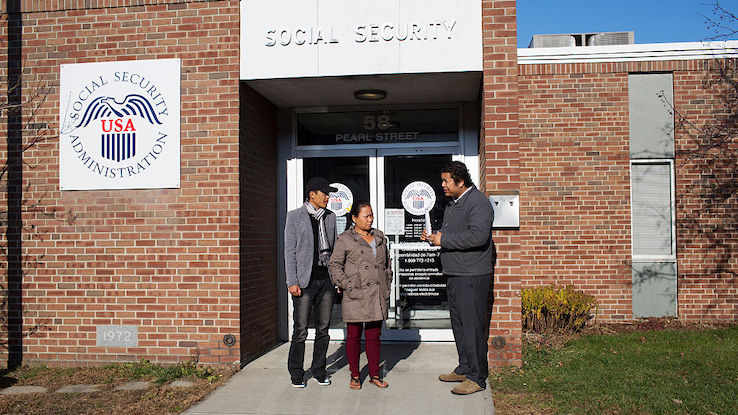
Perhaps the best-known and largest component of Social Security is the retirement benefits it pays out. In that example, these payments are intended to go along people who worked lower-wage jobs throughout their lives from living in relative poverty when they leave the workforce equally they age. Notwithstanding, the Social Security Assistants (SSA) also makes payments to people with disabilities who cannot work and to survivors of workers who've died. According to the SSA, the purposes of these payments are "to provide for the material needs of individuals and families, "to protect aged and disabled persons against the expenses of illnesses that may otherwise use upward their savings" and "to keep families together."
It's important to notation that Social Security benefits are intended to be supplemental — that is, they're not supposed to serve as someone'south sole source of income when they retire. The benefit payments are meant to provide a heave to other retirement income, such as a alimony.
Social Security Eligibility: The Credit System
Depending on your life circumstances, you could be eligible to receive Social Security benefits at whatever age — not just the traditional retirement age of 62. For example, to receive disability benefits, yous may be eligible at nearly any historic period as long equally you lot've worked long enough and recently enough and have a qualifying medical condition that limits your ability to piece of work. Y'all may also be able to receive survivors benefits in some circumstances if yous're a surviving family member of a deceased person who "worked long enough in jobs insured under Social Security to qualify for benefits."

Inability and survivors benefit payments have relatively straightforward eligibility requirements to come across. Social Security retirement benefits do as well, but the means eligibility and amounts are determined and the details involved tin can await somewhat complicated at showtime glance. Understanding eligibility for Social Security benefits involves learning about credits first.
Your eligibility for receiving Social Security is based in function on credits that you earn while working. When you're employed and Social Security taxes are deducted from your paycheck for receipt past the Internal Revenue Service (IRS) y'all commencement earning credits. These credits are based on the amount of money you lot earn each year, and you can earn up to four credits per yr. For example, in 2020, earning $i,410 in wages at your task earns you one credit. Using this number as another instance, once you've earned $five,640 ($i,410 10 four) in wages from your task, y'all've earned your four credits for the twelvemonth and cannot earn more than credits until the next year. The base of operations corporeality of money you demand to earn from your job to earn one credit increases slightly each year to account for inflation.
To qualify to receive Social Security retirement benefits, you must earn at least forty credits, which equates to 10 years' worth of work. You don't need to work 10 sequent years to earn the credits, however. Any credits y'all receive remain on your Social Security tape, and if you leave a job and return to the workforce years later, you can begin accumulating credits again until y'all accomplish twoscore and go eligible for benefits payments.
The number of credits needed to determine your eligibility for inability or survivors benefits depends on your age; mostly speaking, the younger yous are, the fewer the number of credits is that you need to become eligible. The age table on the Social Security Administration's website can give you a better idea of the number of credits relative to your age that yous'll need to have earned to determine eligibility for disability or survivors benefits.
What Role Does Your Historic period Play?
As mentioned, age can be a determining factor in the number of credits y'all'll need for eligibility for two types of payments. Notwithstanding, when information technology comes to retirement benefits, your age can also play a function in not only when you're eligible to get-go receiving payments but also in the amounts of those payments. In item, y'all'll want to think about the historic period at which you determine to commencement claiming your Social Security retirement payments.

The age when you lot first challenge determines whether y'all receive 100% of your Social Security benefits. If you're eligible to receive Social Security retirement benefits, you can first getting them every bit early every bit historic period 62. Even so, your payment amounts will be less than they are if you await until what's called your "full retirement age." This is the age at which you're eligible to receive 100% of your benefit corporeality every month, and it's typically betwixt ages 66 and 67, depending on the year you were born. So, drawing earlier than your full retirement age results in y'all receiving a reduced amount in benefits — the Social Security Administration notes that you'll become about 28% less than yous would if you wait until age 66.
Waiting until you're older than total retirement age to quit working and draw benefits can likewise impact the amount you receive every month. Because you lot're working longer, y'all'll receive a larger monthly amount than if you retired at 66. For each month you lot delay claiming benefits, the amount you can receive monthly increases slightly, and if you lot wait until age 70, you'll go 132% of your Social Security benefit amount. Once you turn seventy and haven't started claiming still, your benefit corporeality won't keep increasing, and so that 132% is the most you can get each month if you delay challenge to go along working.
Source: https://www.askmoney.com/investing/understanding-your-social-security-benefits?utm_content=params%3Ao%3D1465803%26ad%3DdirN%26qo%3DserpIndex

Post a Comment for "what to bring for a new social security card"